
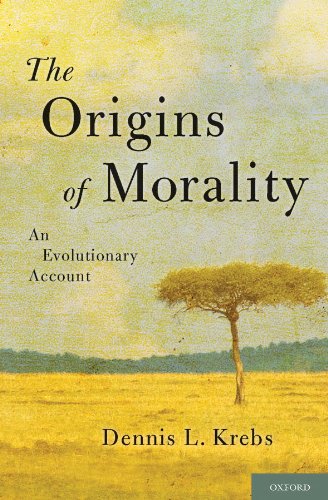
The Origins of Morality: An Evolutionary Account
Product details
| Management number | 231611291 | Release Date | 2026/06/18 | List Price | US$21.76 | Model Number | 231611291 | ||
|---|---|---|---|---|---|---|---|---|---|
| Category | |||||||||
Why do people behave in moral ways in some circumstances, but not in others? In order to account fully for morality, Dennis Krebs departs from traditional approaches to morality that suggest that children acquire morals through socialization, cultural indoctrination, and moral reasoning. He suggests that such approaches can be subsumed, refined, and revised gainfully within an evolutionary framework. Relying on evolutionary theory, Krebs offers an account of how notions of morality originated in the human species. He updates Darwin's early ideas about how dispositions to obey authority, to control antisocial urges, and to behave in altruistic and cooperative ways originated and evolved, then goes on to update Darwin's account of how humans acquired a moral sense.Krebs explains why the theory of evolution does not dictate that all animals are selfish and immoral by nature. On the contrary, he argues that moral behaviors and moral judgments evolved to serve certain functions. Krebs examines theory and research on the evolution of primitive forms of prosocial conduct displayed by humans and other animals, then discusses the evolution of uniquely human prosocial behaviors. He describes how a sense of morality originated during the course of human evolution through strategic social interactions among members of small groups, and how it was expanded and refined in modern societies, explaining how this sense gives rise to culturally universal and culturally relative moral norms. Krebs argues that although humans' unique cognitive abilities endow them with the capacity to engage in sophisticated forms of moral reasoning, people rarely live up their potential in their everyday lives. Four conceptions of what it means to be a moral person are identified, with the conclusion that people are naturally inclined to meet the standards of each conception under certain conditions. The key to making the world a more moral place lies in creating environments in which good guys finish first and cheaters fail to prosper. Read more
| ASIN | B00AJIGIQS |
|---|---|
| XRay | Not Enabled |
| Format | Print Replica |
| ISBN13 | 978-0199778478 |
| Edition | Illustrated |
| Language | English |
| File size | 6.0 MB |
| Page Flip | Not Enabled |
| Publisher | Oxford University Press |
| Word Wise | Not Enabled |
| Print length | 320 pages |
| Accessibility | Learn more |
| Publication date | July 1, 2011 |
| Enhanced typesetting | Not Enabled |
Bestseller ranking
Boy Crib Bedding Sets




Customers who viewed this product also viewed
Gravol






Correction of product information
If you notice any omissions or errors in the product information on this page, please use the correction request form below.
Correction Request Form